
Web development changes faster than people change their smartphone wallpapers. One year everyone is talking about one framework, and the next year there is already a “better and faster” option. In 2026, developers are seeing major changes in how websites are built, optimized, and maintained.
The good news? You do not need to learn every new technology that appears on social media. The smart approach is to understand the trends that are actually shaping the future of the web.
In this article, we will explore the top web development trends in 2026 that every developer should know.
Why Web Development Is Changing So Fast
Technology is growing rapidly because users expect more from websites than ever before. People want websites that are:
- Faster
- More secure
- Mobile-friendly
- Interactive
- Personalized
- Powered by artificial intelligence
Nobody likes waiting for a website to load. In fact, if a page takes too long, users often leave before the logo even finishes appearing.
As the famous internet rule says:
“Loading… please wait” is one of the scariest sentences online.
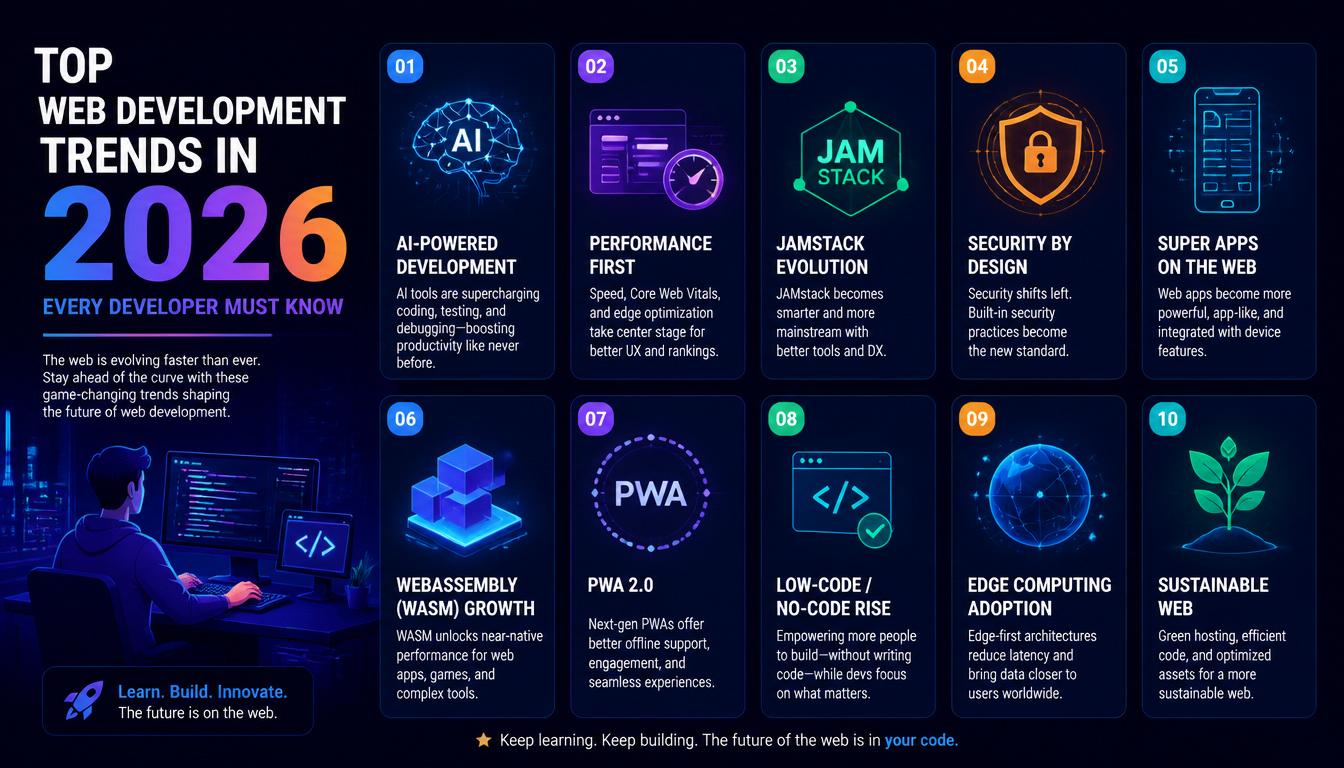
1. AI-Powered Web Development
Artificial Intelligence is becoming a huge part of web development in 2026. Developers are using AI tools to write code, fix bugs, generate content, and even design interfaces.
AI coding assistants can now help developers:
- Generate code snippets
- Detect errors quickly
- Improve website performance
- Suggest security improvements
- Create documentation automatically
However, AI is not replacing developers. It is more like having a very fast assistant that occasionally gives strange suggestions.
For example, sometimes AI may write excellent code. Other times, it might produce something that looks like it was created after drinking too much coffee.
Benefits of AI in Development
| Feature | Benefit |
|---|---|
| Code Generation | Faster development |
| Error Detection | Fewer bugs |
| Content Suggestions | Better productivity |
| Automation | Saves time |
2. Progressive Web Apps (PWAs) Continue Growing
Progressive Web Apps are becoming increasingly popular in 2026.
A PWA combines the best features of websites and mobile applications. Users can install them directly from the browser without visiting an app store.
Popular advantages include:
- Fast loading speed
- Offline functionality
- Push notifications
- Lower development costs
Companies prefer PWAs because maintaining one application is often cheaper than building separate Android and iPhone apps.
Many users cannot even tell whether they are using a website or an app anymore—and honestly, neither can some developers after working late at night.
3. Serverless Architecture Is Becoming Mainstream
Serverless computing continues to gain popularity.
Despite the name, servers still exist. They are simply managed by cloud providers instead of developers.
This allows developers to focus more on building features and less on managing infrastructure.
Advantages of Serverless Development
- Lower hosting costs
- Automatic scaling
- Faster deployment
- Less server management
Major cloud providers continue expanding their serverless services, making this trend even more important in 2026.
4. WebAssembly (Wasm) Is Expanding
WebAssembly is helping websites become much faster.
It allows developers to run high-performance applications directly in browsers using languages like:
- C++
- Rust
- Go
- C#
This opens new possibilities for:
- Browser games
- Video editing tools
- 3D applications
- Advanced business software
A few years ago, editing videos inside a browser sounded impossible. In 2026, it is becoming normal.
The browser is slowly turning into a mini operating system.
5. API-First Development
Modern applications depend heavily on APIs.
Instead of building everything together, developers now create systems where APIs connect different services.
Examples include:
- Payment systems
- Authentication services
- Chat applications
- AI integrations
- Analytics tools
API-first development provides flexibility and makes applications easier to scale.
Popular API Technologies
| Technology | Purpose |
|---|---|
| REST | Standard API communication |
| GraphQL | Flexible data fetching |
| gRPC | High-performance communication |
| WebSockets | Real-time updates |
APIs are now like the “universal language” of software development.
6. Low-Code and No-Code Platforms
Low-code platforms continue growing rapidly.
Businesses want applications quickly, and low-code tools help reduce development time.
This does not mean developers will disappear.
Instead, developers are increasingly becoming:
- Solution architects
- Integration specialists
- Performance experts
No-code tools are great for simple projects, but complex systems still need professional developers.
After all, building a large business platform using only drag-and-drop tools can sometimes become an adventure nobody asked for.
7. Cybersecurity Is More Important Than Ever
Cyber threats continue increasing every year.
As websites become more advanced, security becomes even more critical.
Developers in 2026 must pay attention to:
Important Security Practices
- Multi-factor authentication
- Secure APIs
- Data encryption
- Regular security testing
- Zero-trust architecture
Users are becoming more aware of privacy issues.
One security mistake can damage a company’s reputation very quickly.
Remember:
A beautiful website with poor security is like a luxury house with no doors.
8. Edge Computing and Edge Functions
Edge computing is changing how websites deliver content.
Instead of processing requests in one central server, data is processed closer to the user.
Benefits include:
- Faster loading times
- Better performance
- Reduced latency
- Improved user experience
This trend is especially important for:
- Streaming platforms
- Gaming services
- E-commerce websites
- Global applications
Nobody enjoys waiting for pages to load, especially in 2026 when people expect everything instantly.
Some users become impatient if a website takes longer than making instant noodles.
9. Voice Search Optimization
Voice technology keeps growing.
More users now search using:
- Smartphones
- Smart speakers
- Virtual assistants
Developers and SEO professionals need to optimize websites for conversational searches.
Instead of typing:
“weather Phnom Penh”
Users may ask:
“What is the weather like in Phnom Penh today?”
This changes how websites structure content and metadata.
Voice-friendly websites may gain a competitive advantage in the coming years.
10. Motion UI and Interactive Design
Modern websites are becoming more dynamic.
Users expect:
- Smooth animations
- Interactive elements
- Better transitions
- Micro-interactions
Small animations can greatly improve user experience.
Examples include:
- Animated buttons
- Loading effects
- Scroll-based animations
- Interactive product previews
However, developers should avoid adding too many animations.
Nobody wants a website that feels like a disco party from the early 2000s.
Balance is important.
11. Sustainable and Green Web Development
Environmental awareness is influencing web development.
Developers are now considering:
- Efficient coding practices
- Smaller image sizes
- Reduced server usage
- Lower energy consumption
Green web development aims to create websites that consume fewer resources.
Simple Ways to Build Eco-Friendly Websites
| Method | Result |
|---|---|
| Image Optimization | Faster loading |
| Cleaner Code | Lower resource usage |
| Efficient Hosting | Reduced energy consumption |
| Caching | Less server processing |
Sustainability is becoming a real business concern in 2026.
12. Headless CMS Adoption Continues
Headless CMS platforms are becoming increasingly popular.
Unlike traditional CMS systems, headless solutions separate content management from presentation.
Benefits include:
- Better flexibility
- Multi-platform publishing
- Improved performance
- Easier integrations
Content can be delivered to:
- Websites
- Mobile apps
- Smart devices
- Digital displays
This approach works especially well for businesses managing content across multiple channels.
Skills Developers Should Learn in 2026
The technology landscape keeps changing, but some skills are becoming increasingly valuable.
Important Skills
- JavaScript and TypeScript
- API development
- Cloud computing
- AI integration
- Cybersecurity basics
- Performance optimization
- Database management
- DevOps practices
Developers do not need to master everything immediately.
Learning one new skill at a time is much better than trying to learn ten frameworks in one weekend and remembering none of them on Monday.
Future Outlook of Web Development
The future of web development looks exciting.
Websites are becoming:
- Smarter
- Faster
- More personalized
- More interactive
- More secure
Artificial intelligence, cloud technologies, and advanced browser capabilities will continue reshaping the industry.
Developers who stay curious and continue learning will have many opportunities in the coming years.
Technology trends may change, but one thing remains constant:
There will always be another JavaScript framework waiting around the corner.
Conclusion
Web development in 2026 is moving toward greater automation, performance, and user experience. Technologies such as AI-powered development, Progressive Web Apps, serverless computing, WebAssembly, edge computing, and stronger cybersecurity practices are becoming essential.
The key lesson for developers is simple: keep learning and stay flexible.
You do not need to chase every trend, but understanding the major changes can help you remain competitive in the industry.
The web keeps evolving, and developers who adapt will continue building amazing digital experiences.



Leave a Reply