
The world of web development moves incredibly fast. A tool that looks modern today can feel old-fashioned next year. In 2026, developers have access to powerful frameworks, AI-assisted coding tools, and faster deployment platforms than ever before. Building websites is no longer just about writing HTML and CSS for hours while drinking five cups of coffee. Today, developers can create complex applications much faster and smarter.
Whether you are a beginner starting your first website or an experienced developer building enterprise applications, choosing the right tools can save time, reduce stress, and even make coding more enjoyable.
Let’s explore the best web development tools and frameworks that are shaping the web development industry in 2026.
Why Choosing the Right Tools Matters
Imagine trying to build a modern skyscraper using only a hammer and a screwdriver. It would be possible, but it would take forever.
The same idea applies to web development.
Modern tools help developers:
- Build websites faster
- Reduce coding errors
- Improve website performance
- Enhance security
- Make teamwork easier
- Deploy projects with fewer headaches
Good tools do not replace developers. They simply make developers look like superheroes.
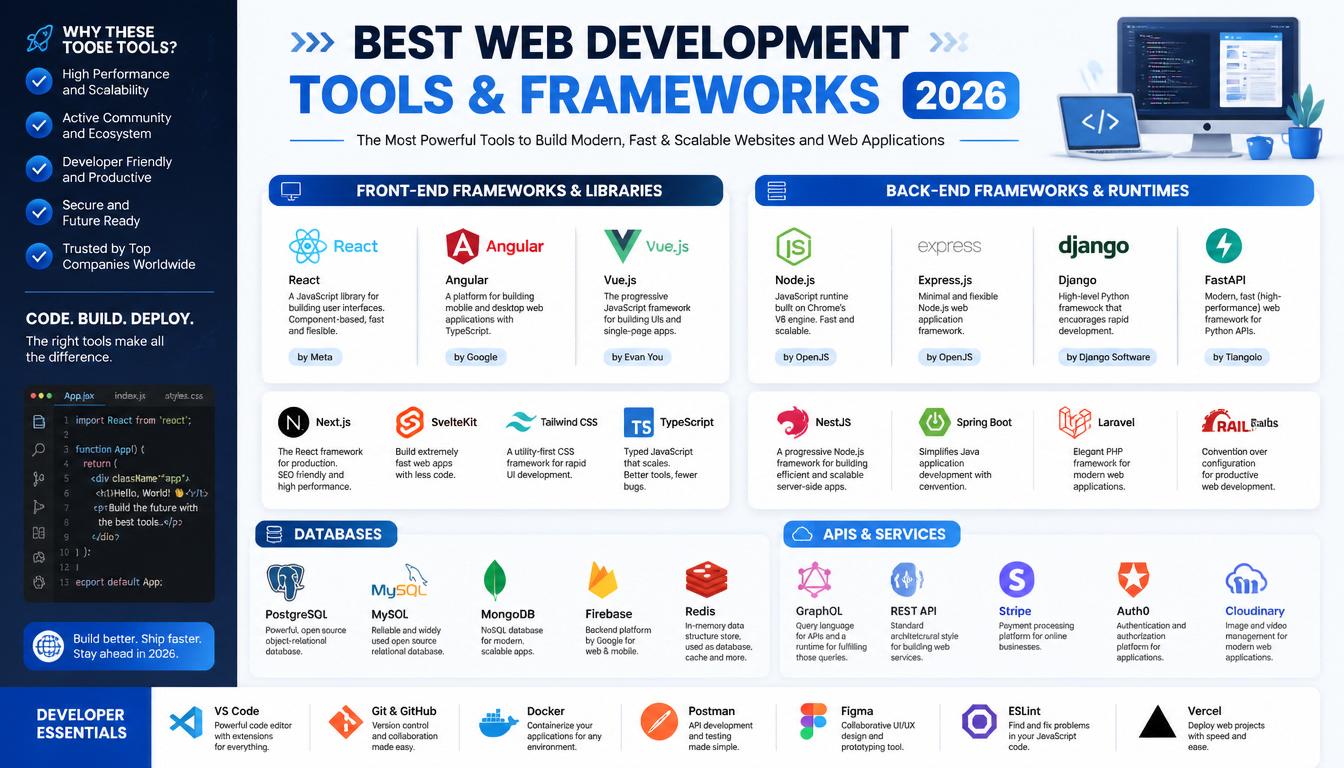
Top Web Development Frameworks in 2026
1. React
React continues to dominate the frontend world in 2026. Developed by Meta, React remains one of the most popular JavaScript libraries for building user interfaces.
Why Developers Love React
- Component-based architecture
- Huge community support
- Excellent ecosystem
- Strong job market demand
- Easy integration with other tools
React is particularly useful for:
- Social media platforms
- Dashboards
- E-commerce websites
- Single-page applications
One funny thing about React developers is that they often create components for everything. Sometimes even the button inside another button gets its own component.
Advantages
✔ Large community
✔ Massive learning resources
✔ Excellent performance
Disadvantages
✖ Frequent updates
✖ Can become complex in large projects
2. Next.js
Next.js has become one of the biggest stars in web development.
It extends React and offers:
- Server-side rendering
- Static site generation
- Better SEO
- Faster loading times
- Simplified routing
Businesses love Next.js because Google also loves fast websites.
Best Use Cases
- Company websites
- Blogs
- Online stores
- Large-scale applications
In 2026, many developers joke that if someone says they use React, the next question is usually:
“Okay… but are you using Next.js?”
3. Vue.js
Vue remains one of the easiest frameworks to learn.
Its simple structure makes it ideal for beginners who want powerful features without excessive complexity.
Why Vue Is Popular
- Beginner-friendly
- Lightweight
- Excellent documentation
- Flexible architecture
Many developers describe Vue as the “friendly neighbor” of JavaScript frameworks.
4. Angular
Angular continues to be a favorite among enterprise companies.
Created by Google, Angular offers an all-in-one solution with built-in tools for routing, forms, and state management.
Ideal For
- Banking systems
- Enterprise dashboards
- Large business applications
Angular may have a steeper learning curve, but once mastered, it becomes a very powerful framework.
5. Svelte
Svelte keeps gaining popularity in 2026 because of its simplicity and impressive performance.
Unlike traditional frameworks, Svelte compiles code during build time, producing highly optimized applications.
Benefits
- Smaller bundle sizes
- Faster performance
- Cleaner syntax
- Less boilerplate code
Developers often say:
“With Svelte, you write less code and somehow get more done.”
That sounds almost magical.
Best Backend Frameworks in 2026
1. Node.js with Express
JavaScript continues to dominate both frontend and backend development.
Express remains one of the easiest backend frameworks.
Advantages
- Fast development
- Huge package ecosystem
- Easy API creation
- Large developer community
Perfect for:
- APIs
- Real-time applications
- Chat systems
- Startups
2. NestJS
NestJS has become extremely popular among professional developers.
It brings structure and scalability to Node.js applications.
Features
- TypeScript support
- Dependency injection
- Clean architecture
- Enterprise-level scalability
Large teams especially appreciate NestJS because it keeps projects organized.
Without structure, large applications can quickly turn into spaghetti code. And nobody likes spaghetti code unless it is served with cheese.
3. Laravel
PHP is still alive in 2026, despite years of internet jokes claiming otherwise.
Laravel remains one of the best PHP frameworks.
Why Laravel Survives
- Elegant syntax
- Built-in authentication
- Great security features
- Excellent documentation
Laravel powers millions of websites and continues to be a strong option for businesses.
4. Django
Python’s popularity continues growing, making Django a major player.
Strengths
- High security
- Fast development
- Excellent for data-driven applications
- AI and machine learning integration
Django is especially popular for:
- Educational platforms
- AI applications
- Content management systems
Best Development Tools in 2026
1. Visual Studio Code
Visual Studio Code remains the king of code editors.
Almost every developer has VS Code installed.
Why It Dominates
- Lightweight
- Thousands of extensions
- AI integrations
- Git support
- Excellent debugging tools
At this point, many developers probably spend more time customizing VS Code themes than actually writing code.
2. GitHub Copilot
AI coding assistants have become a normal part of development.
GitHub Copilot helps developers:
- Generate code
- Explain functions
- Write tests
- Suggest improvements
It does not replace developers, but it definitely reduces repetitive work.
Think of it as a coding assistant that never asks for coffee breaks.
3. Docker
Docker remains essential for modern development.
Benefits
- Consistent environments
- Easier deployment
- Better collaboration
- Faster testing
Developers no longer need to hear:
“It works on my machine.”
Docker makes sure it works on everyone’s machine.
4. Postman
API development continues to grow, and Postman remains a favorite tool.
Features
- API testing
- Documentation
- Team collaboration
- Automated workflows
For backend developers, Postman often becomes one of the most frequently used applications.
5. Figma
Design and development collaboration has become much smoother thanks to Figma.
Why Developers Love It
- Easy design sharing
- Live collaboration
- Responsive prototypes
- Component systems
Designers and developers may still argue occasionally, but Figma certainly reduces misunderstandings.
Best Deployment Platforms in 2026
1. Vercel
Vercel has become incredibly popular, especially among React and Next.js developers.
Advantages
- Fast deployment
- Automatic optimization
- Global CDN
- Easy integrations
Deploying a website often takes only a few clicks.
2. Netlify
Netlify remains a fantastic choice for static websites and JAMstack applications.
Popular Features
- Serverless functions
- Continuous deployment
- Form handling
- Easy hosting
3. Cloudflare Pages
Cloudflare continues expanding its services.
Developers appreciate:
- Strong security
- Excellent speed
- Affordable pricing
- Edge computing support
Comparison Table of Popular Frameworks
| Framework | Language | Difficulty | Best For | Popularity |
|---|---|---|---|---|
| React | JavaScript | Medium | Interactive UI | Very High |
| Next.js | JavaScript | Medium | SEO Websites | Very High |
| Vue.js | JavaScript | Easy | Beginners | High |
| Angular | TypeScript | Hard | Enterprise Apps | High |
| Svelte | JavaScript | Easy | Performance Apps | Growing |
| Django | Python | Medium | Data Platforms | High |
| Laravel | PHP | Easy | Business Websites | High |
| NestJS | TypeScript | Medium | Large APIs | Growing |
Essential Tools Every Developer Should Learn
| Tool | Purpose |
|---|---|
| VS Code | Code Editing |
| Git | Version Control |
| Docker | Containerization |
| Postman | API Testing |
| Figma | UI Collaboration |
| GitHub Copilot | AI Assistance |
| Vercel | Deployment |
| Cloudflare | Performance & Security |
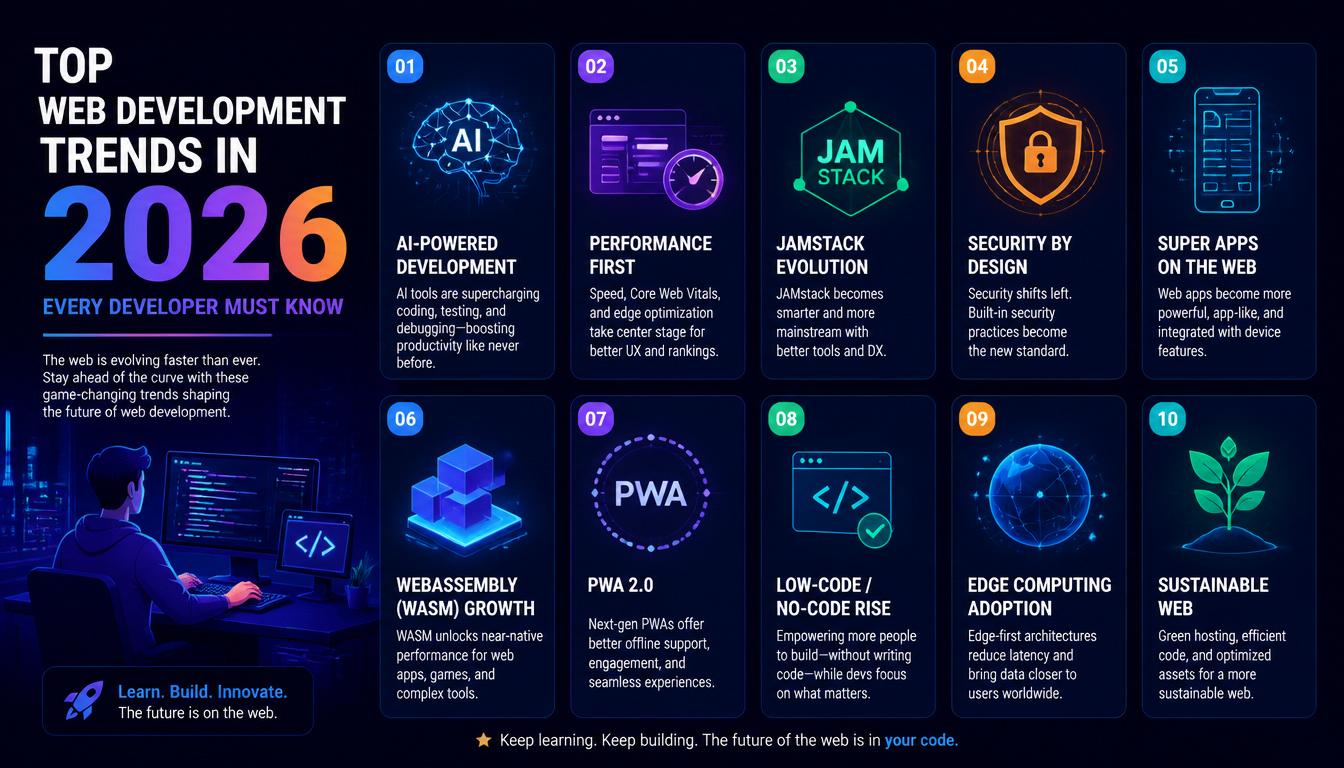
Web Development Trends Influencing Tools in 2026
Several trends are shaping the tools developers choose:
AI-Assisted Development
AI is helping developers write code faster and debug problems more efficiently.
Serverless Computing
Developers increasingly prefer focusing on application logic instead of server management.
Edge Computing
Applications are moving closer to users, resulting in faster loading times.
TypeScript Growth
TypeScript continues replacing plain JavaScript in large projects due to better maintainability.
Performance-First Development
Users expect websites to load instantly. Nobody enjoys staring at a loading spinner for ten seconds.
How Beginners Should Choose a Framework
If you are just starting, you do not need to learn everything at once.
A simple learning path could look like this:
- HTML
- CSS
- JavaScript
- React or Vue
- Node.js
- Git and GitHub
- Deployment tools
Trying to learn ten frameworks at the same time is like trying to watch ten movies simultaneously. You end up understanding none of them.
Final Thoughts
Web development in 2026 is more exciting than ever. Developers now have access to amazing frameworks and intelligent tools that make building websites faster, safer, and more enjoyable.
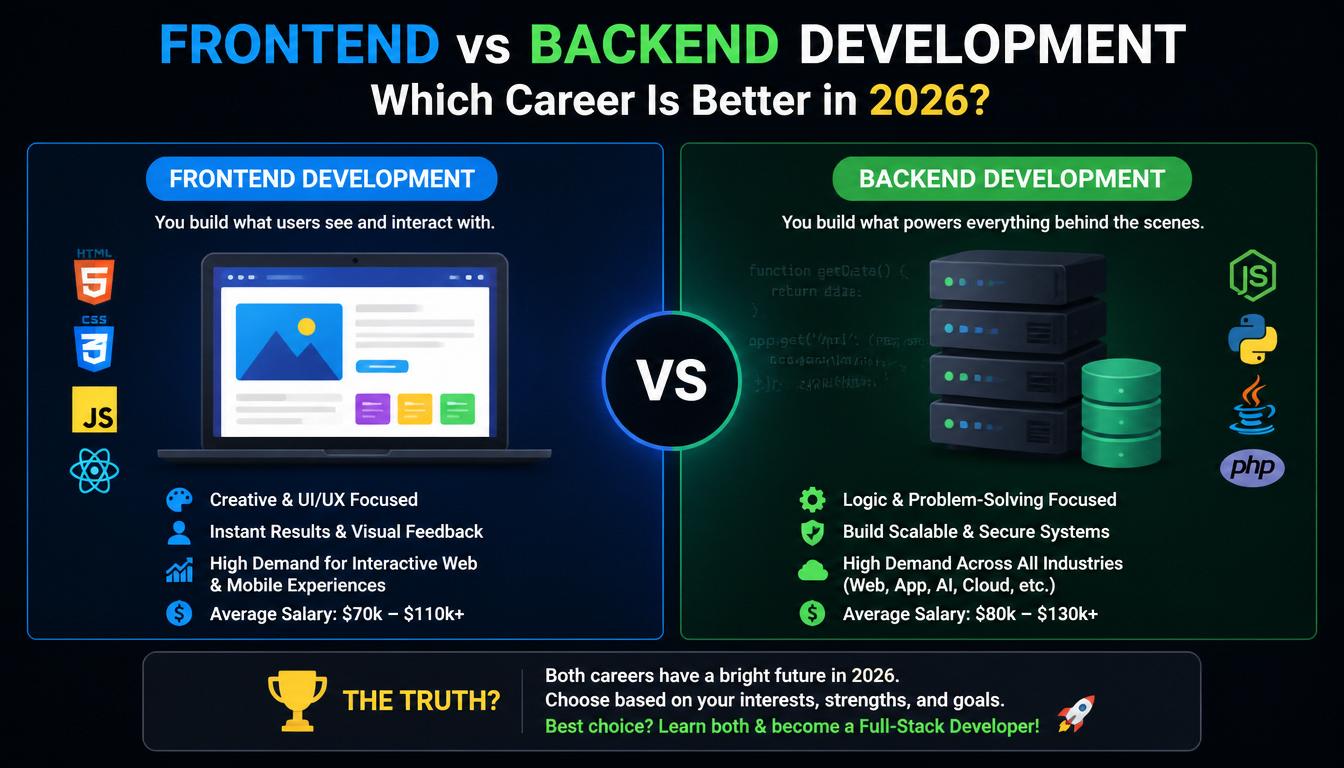
For frontend development, React and Next.js remain dominant choices, while Vue and Svelte continue attracting developers looking for simplicity and performance.
On the backend, Node.js, NestJS, Django, and Laravel provide powerful options for different types of projects.
Meanwhile, tools like VS Code, Docker, GitHub Copilot, Vercel, and Cloudflare are becoming almost essential parts of the modern developer workflow.
The best tool ultimately depends on your goals. There is no perfect framework for every situation. However, learning the major tools of 2026 will put developers in a strong position for future projects and career opportunities.
And remember, every experienced developer was once a beginner who spent three hours looking for a missing semicolon.




Leave a Reply